
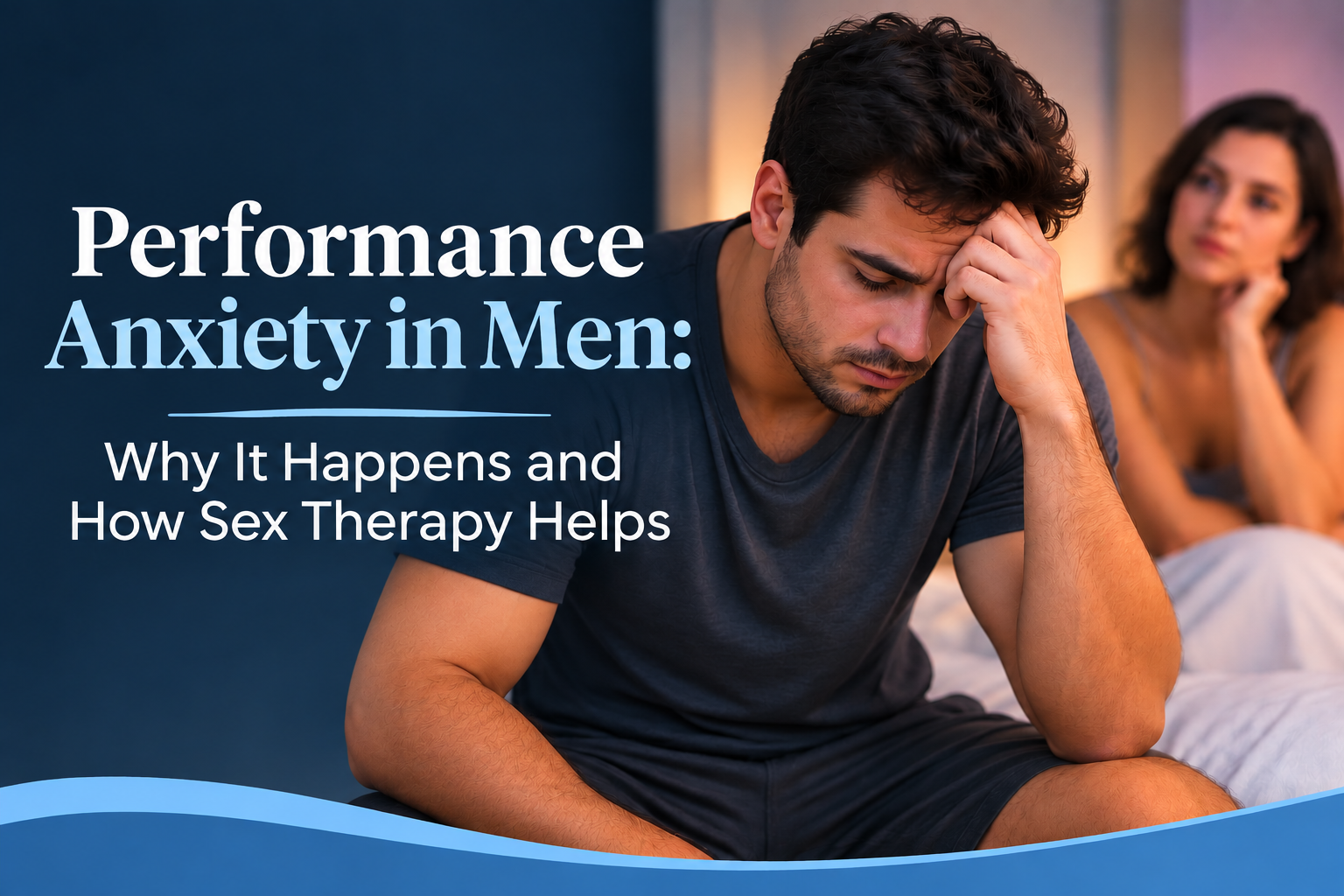
Performance Anxiety in Men: Why It Happens and How Sex Therapy Helps.
When Intimacy Starts to Feel Like Pressure
Sexual intimacy is often portrayed as something that should happen naturally. Men are frequently expected to feel confident, take the lead, and perform without hesitation.
But what happens when intimacy becomes a source of stress instead of connection?
For some men, the thought of sexual activity brings worry, self-doubt, or fear of disappointing a partner. They may become preoccupied with maintaining an erection, lasting long enough, satisfying their partner, or meeting expectations about what a sexual experience should look like.
This experience is commonly known as sexual performance anxiety.
Although it can feel isolating, performance anxiety is not a sign of weakness or a measure of masculinity. It is a concern that can affect men of different ages, relationship statuses, and backgrounds.
The good news is that understanding what contributes to performance anxiety can be an important first step toward improving confidence, reducing pressure, and rebuilding intimacy.
At Douté Counseling Services, sex therapy provides a supportive space for individuals and couples to explore intimacy challenges and develop healthier ways to approach their sexual relationships.
What Is Sexual Performance Anxiety in Men?
Sexual performance anxiety occurs when worry about sexual performance interferes with a person’s ability to feel present, comfortable, and engaged during intimacy.
Rather than focusing on connection and pleasure, a man may become focused on evaluating his performance.
He might think:
• “What if I cannot maintain an erection?”
• “What if I disappoint my partner?”
• “What if this happens again?”
• “Will my partner think I am no longer attracted to them?”
• “Am I supposed to perform better than this?”
These thoughts can create pressure before or during sexual activity.
Performance anxiety can contribute to erectile difficulties, reduced sexual desire, difficulty reaching orgasm, or avoiding intimacy. However, these experiences can also have physical or medical causes, and anxiety is not always the primary explanation.
When the fear of experiencing a problem becomes a problem of its own, it may be helpful to explore the emotional and psychological factors involved.
Why Does Performance Anxiety Happen?
There is rarely one explanation for sexual performance anxiety. It may develop through a combination of psychological, relational, physical, and situational factors.
1. Fear of Failure and Unrealistic Expectations
Many men grow up receiving messages that masculinity is connected to sexual ability, endurance, and confidence.
These expectations can make ordinary variations in sexual response feel like personal failures.
When a man believes he must always be ready for sex, maintain an erection, or satisfy his partner every time, intimacy can become a performance rather than a shared experience.
Over time, the pressure to succeed may make it more difficult to relax and enjoy the moment.
Healthy intimacy does not require perfection. It requires communication, mutual respect, and room for both partners to express their needs.
2. Stress, Anxiety, and Mental Overload
Work responsibilities, financial concerns, family pressures, and everyday stress can affect emotional well-being and sexual functioning.
When the mind is occupied with worries, it may be difficult to feel relaxed and connected during intimacy.
Anxiety can also activate the body’s stress response, making it harder to remain present and comfortable.
A man may begin anticipating a problem before sexual activity even starts. This anticipation can increase tension and reinforce his fear that something will go wrong.
3. Previous Sexual Experiences
A single difficult or disappointing sexual experience does not necessarily indicate an ongoing problem.
However, if an experience creates embarrassment or fear, a man may begin worrying that it will happen again.
For example, experiencing difficulty maintaining an erection once may lead to constant monitoring during future encounters.
Instead of focusing on his partner or his own sensations, he may repeatedly ask himself whether his body is responding as expected.
This heightened self-monitoring can increase anxiety and make intimacy feel less spontaneous.
4. Relationship Conflict and Fear of Disappointing a Partner
Sexual concerns do not always begin in the bedroom.
Unresolved disagreements, communication difficulties, emotional distance, or fear of rejection can affect how safe and connected partners feel with one another.
A man who worries about disappointing his partner may experience additional pressure during intimacy.
In some relationships, sexual difficulties become difficult to discuss. One partner may withdraw, while the other interprets the withdrawal as rejection or a lack of attraction.
This can create misunderstandings that intensify the original concern.
Learning to discuss intimacy without blame or criticism can help couples understand one another and reduce unnecessary pressure.
5. Aging and Changes in Sexual Health
Sexual response can change with age, and these changes do not automatically mean that a man has lost his masculinity or ability to enjoy intimacy.
Stress, sleep quality, medications, chronic health conditions, hormonal changes, and cardiovascular health may influence sexual functioning.
When a man notices changes in his body, he may become anxious about whether they will continue or worsen.
It is important to recognize that sexual performance concerns are not always psychological. Persistent or new erectile difficulties should be discussed with a qualified healthcare professional to evaluate possible medical causes.
Addressing both physical and emotional factors can be an important part of finding an appropriate path forward.
The Cycle of Sexual Performance Anxiety
One of the most frustrating aspects of performance anxiety is that worrying about a problem can sometimes reinforce it.
Consider this example:
1. A man experiences difficulty during a sexual encounter.
2. He begins worrying that it will happen again.
3. During the next encounter, he monitors his performance instead of remaining present.
4. His anxiety increases, making the experience more stressful.
5. The difficult experience reinforces his fear of future encounters.
Eventually, he may begin avoiding intimacy altogether to prevent embarrassment or disappointment.
His partner may interpret this avoidance as rejection, creating additional tension in the relationship.
Breaking this cycle begins with understanding it—not blaming yourself for it. Recognizing the relationship between thoughts, emotions, physical responses, and behavior can help a man approach intimacy with greater awareness and less pressure.
How Does Sex Therapy Help Men With Performance Anxiety?
Sex therapy offers a professional, nonjudgmental environment to explore concerns about sexual functioning, intimacy, confidence, and relationships.
Rather than treating sexual performance as an isolated issue, therapy can help identify the emotional, behavioral, and relational patterns that may be contributing to the problem.
The specific approach depends on each person’s circumstances and goals.
1. Identifying the Root Causes
Sex therapy can help men explore when their anxiety began, what triggers it, and how it affects their thoughts and behavior.
Sessions may address performance expectations, fear of rejection, previous experiences, stress, or relationship concerns.
Understanding these patterns can make it easier to identify what needs attention and develop a plan suited to the individual’s situation.
2. Challenging Unhelpful Thoughts
Thoughts such as “I must perform perfectly” or “My partner will lose interest if this happens again” can increase emotional pressure.
A therapist may help clients recognize these patterns, evaluate whether their assumptions are accurate, and develop more balanced ways of thinking.
The goal is not to force positive thinking. It is to reduce the power of unrealistic expectations and help men respond to uncertainty with greater flexibility.
3. Developing Stress-Management Skills
Learning to manage stress can support a healthier relationship with intimacy.
Depending on the individual’s needs, therapy may incorporate mindfulness, relaxation strategies, emotional awareness, and other evidence-informed techniques.
These skills can help clients recognize anxious thoughts without automatically reacting to them.
Over time, the focus can shift from constantly evaluating performance toward being more present during intimate experiences.
4. Improving Communication With a Partner
When performance anxiety affects a relationship, open communication can help both partners understand what is happening.
Sex therapy may support conversations about expectations, emotional needs, affection, boundaries, and concerns about rejection.
Partners can learn to approach sexual difficulties as a shared concern rather than a personal failure or an accusation.
For some couples, this process helps reduce misunderstandings and rebuild emotional connection.
5. Reducing Pressure Around Sexual Intimacy
Intimacy does not have to be measured by a particular outcome.
Therapy can help individuals and couples explore ways to experience closeness without making every encounter a test of sexual performance.
Depending on the treatment plan, a therapist may recommend structured exercises that emphasize communication, comfort, and connection rather than achievement.
These exercises should be individualized and discussed with the therapist, especially when physical health concerns or sexual trauma are involved.
6. Rebuilding Confidence and Self-Understanding
Confidence develops through understanding, practice, and a healthier relationship with oneself.
Sex therapy can help men separate their self-worth from their sexual performance and explore the beliefs that make intimacy feel threatening.
The goal is not to promise perfect performance. It is to support a more flexible, confident, and connected approach to sexual health.
Should You Consider Sex Therapy?
You may benefit from professional support if you notice that:
• You frequently worry about your sexual performance before intimacy.
• You experience recurring anxiety about erections, orgasm, or satisfying your partner.
• You avoid sexual encounters because you fear embarrassment.
• You find yourself monitoring your body’s response instead of enjoying intimacy.
• Sexual concerns are creating conflict, distance, or misunderstandings in your relationship.
• Your confidence or self-esteem has been affected by ongoing sexual difficulties.
• You want to communicate more openly about intimacy but do not know where to begin.
You do not need to wait until your relationship reaches a crisis point to seek help.
If these concerns are affecting your well-being, speaking with a qualified professional can help you understand your options.
A healthcare professional can also evaluate persistent sexual-function changes and determine whether medical assessment or treatment is appropriate.
What Happens During Sex Therapy?
Starting a conversation about sexual concerns can feel uncomfortable, especially if you have never discussed these experiences with a professional.
Sex therapy provides a structured setting where you can explore your concerns at a pace that feels manageable.
Depending on your goals, sessions may involve:
• Discussing your experiences, concerns, and expectations.
• Exploring emotional and relationship factors affecting intimacy.
• Identifying patterns that increase anxiety.
• Learning communication and coping strategies.
• Developing individualized goals for improving sexual well-being.
Sex therapy is a form of professional talk therapy. It does not involve sexual activity with the therapist.
You can ask questions, share only what you feel ready to discuss, and work collaboratively with your therapist on appropriate next steps.
The purpose is to create a respectful environment where sexual concerns can be addressed openly, without shame or unnecessary judgment.
You Do Not Have to Navigate Performance Anxiety Alone
Sexual performance anxiety can affect confidence, relationships, and the ability to enjoy intimacy. But experiencing these concerns does not define you, and it does not mean you have failed as a man or a partner.
Understanding the underlying factors can help you move away from self-blame and toward meaningful change.
Whether your concerns are connected to stress, expectations, relationship challenges, or previous experiences, professional support can help you explore what is happening and identify strategies that fit your needs.
The first step does not have to be a dramatic one. Sometimes, it begins with being willing to talk about something you have kept to yourself.
Take the Next Step Toward Healthier Intimacy
If performance anxiety is affecting your confidence or relationship, you do not have to keep struggling in silence.
Douté Counseling Services, LLC offers sex therapy to help individuals and couples address intimacy challenges in a supportive, professional environment.
You can learn more about the practice’s sex therapy services at https://www.doutecounselingservices.com/sex-and-intimacy-therapy/ or explore available counseling services at https://www.doutecounselingservices.com/services/.
When you are ready, take the next step toward understanding your concerns and working toward healthier intimacy.

Leave a Reply